Azbuka VkusaConcept
Azbuka Vkusa: giving customers control of their order after checkout
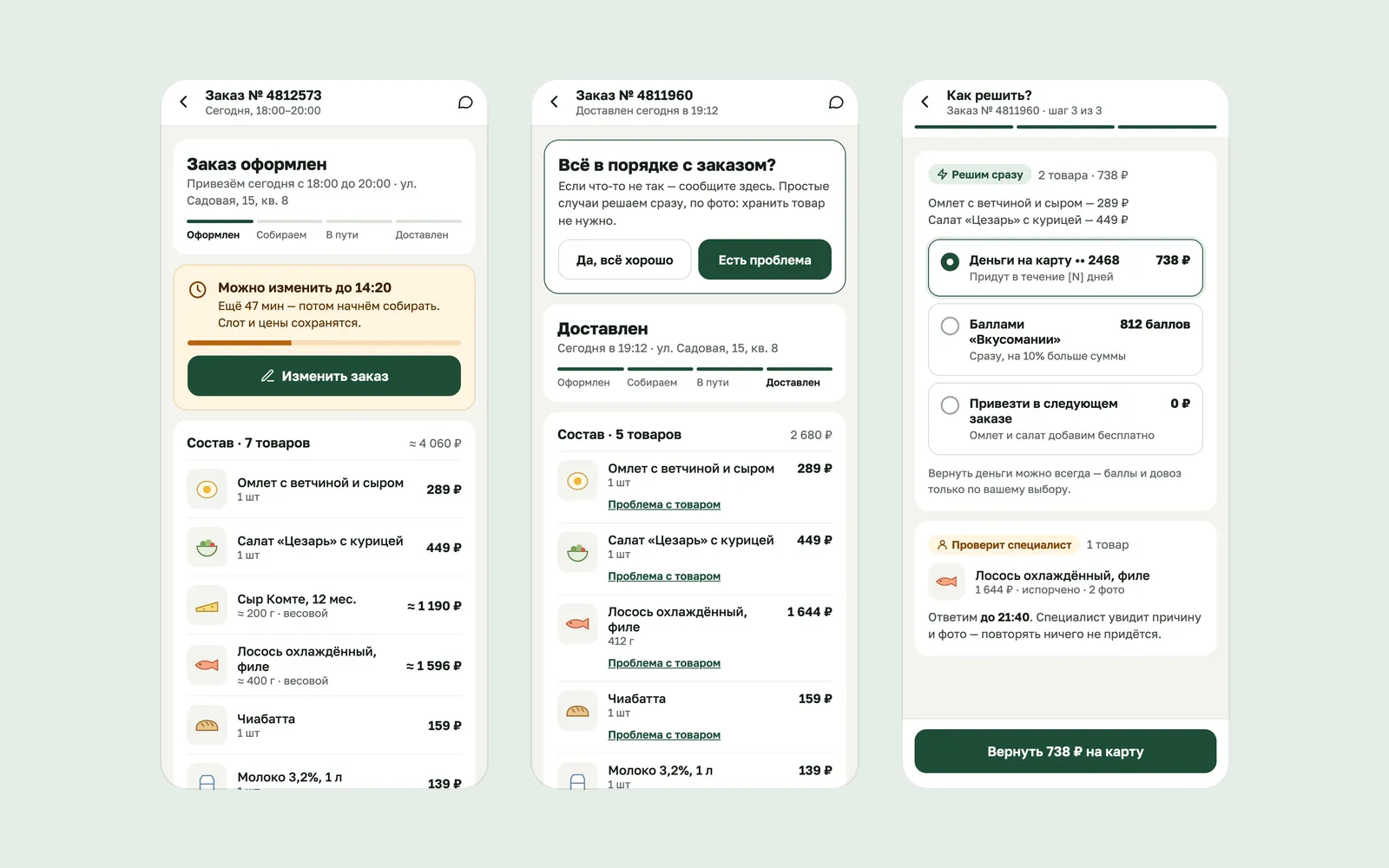
Two status-aware actions in the order card: “Edit order” before picking starts and “Problem with item” for each item after delivery.
Concept, not affiliated with the company. Independent work based on public data and the public version of the product. Metrics are expected, not actual.
- Problem
- Once paid, an order can't be edited or canceled; a spoiled item means canned replies, days of waiting and keeping it as evidence
- My role
- Picked two hypotheses and assessed their evidence, defined principles and the MVP, designed 12 screens and a prototype
- Timeline & team
- 2026 · Solo
- Outcome
- How to measure: share of edits and cancellations in the app rather than via support · repeat order within 30 days of a problem order
Mobile app, order details · iOS / Android · Claude Design
01 · Problem
Control over the order ends at the checkout button
For users
- Remembered a forgotten item after paying — can't add, remove, or cancel
- Spoiled, stale, or missing items — canned replies and days of waiting
- Asked to keep the product as evidence
For the business
- Support load: every change and every complaint goes through chat
- A second order instead of an add-on means an extra delivery
- After a bad experience, customers write a review instead of ordering again
A long delivery loop
Grocery delivery is a long loop: you order at lunch, it arrives in the evening. In between, customers remember something they forgot, and after delivery they may find something spoiled. Either way, there's no action inside the order — only a second order or a support chat.
02 · What I learned
Customers lack control at two points: before picking starts and after delivery
- Review analysis
- Order lifecycle
- Hypothesis prioritization
I mapped the full order lifecycle and found two points where customers lack control: before picking starts and after delivery.
03 · Options and decision
The thinner the evidence, the smaller the first release
I picked two hypotheses from the backlog and assessed their evidence. The “On the way” status is out of scope: the progress bar, delay notice, and time shift already shipped in 2026 releases.
| Hypothesis 5 · Edit before picking | Hypothesis 1 · Problem with item | |
|---|---|---|
| Evidence | Thin: 2 reviews | Moderate |
| Core idea | Fix a paid order without a second delivery | Report a problem faster than writing an angry review |
| MVP | Editing and cancellation in one time-boxed window | Per-item claims, auto-compensation for low-cost items, status and deadline for the rest |
| First release | Cancellation only — as a demand probe | — |
| Metric | Share of edits and cancellations in the app rather than via support | Repeat order within 30 days of a problem order |
Why different first releases
Hypothesis 5 rests on thin evidence — just two reviews. It's too early to build full editing with weighed items and hold recalculation. Cancellation is cheaper to build and will show whether there's demand for changes after payment.
04 · Key decisions
Actions live where the order is, and the limits are visible upfront
Amounts, times, order numbers, and auto-compensation thresholds in the mockups are examples, not real data.
Decision 1
A timed edit window before picking starts
A placed order shows a “You can edit until 14:20” banner with a countdown: the slot and prices are kept. Customers can only add what's in stock at the picking store — no second delivery.
Decision 2
An honest “about” for weighed items
Nothing changes until the customer confirms the edits. We'll raise the card hold, charge the exact amount after picking, and if the weight comes in lower, we won't charge the difference.
Decision 3
A photo is the evidence — no need to keep the product
Every item in a delivered order has a “Problem with item” link, and all problem items go into one claim. A hint says what to shoot: the label with the expiry date, the packaging, the product; for food poisoning or a foreign object there's no form — we call back.
Decision 4
Low-cost items are resolved instantly, and the customer chooses how
Money to card, points, or redelivery — money is always an option. Expensive items go to a specialist with a response deadline.
All screens (6)
Five solution principles
- Act where the order is — from the order card and the item, not a generic chat.
- Show what's still possible — the status says until when.
- Resolve first, investigate later — a photo is the evidence; no need to keep the product.
- The customer chooses — money, points, or redelivery; money is always an option.
- Honest timelines — if a human is needed, the status and response time are visible.
Cancellation and the closed window
From a product page — “Add to order for 18:00–20:00”. The cancel screen reminds that the order can be edited and shows what will be returned: money, points, promo code. If picking starts while the customer is editing, the changes aren't lost — the items move to the cart for the next order. After 14:20 the buttons are replaced with “Editing is no longer possible — the picker is on the floor” and a link to chat.
Result and status
After delivery — “Is everything OK with your order?”. Someone else's order gets a separate path to a specialist. At the end — a result screen and the claim status in the order card: what was refunded, what's under review, and when to expect an answer.
05 · Results
Success means edits move out of chat and customers come back after a problem
This is a concept, so this is a measurement plan: one primary metric per hypothesis and a demand probe for the first release.
| Metric | Why | Expected |
|---|---|---|
| Share of edits and cancellations in the app rather than via support | Primary for hypothesis 5: the edit window replaces the chat | Increase |
| Repeat order within 30 days of a problem order | Primary for hypothesis 1: the issue was resolved well enough that the customer stayed | Increase |
| Demand for cancellation in the first release | Demand probe for hypothesis 5 before full editing | Go/no-go for phase two |
Guardrails I'd add: auto-compensation cost per order, share of disputed photo claims, picking failures caused by last-minute changes.